[Paper Reivew] Neural Discrete Representation Learning & Generating Diverse High-Fidelity Images with VQ-VAE-2
VQ-VAE, VQ-VAE2 의 간단한 요약입니다.

Neural Discrete Representation Learning
NeurIPS 2017 [Paper]
Aaron van den Oord, Oriol Vinyals, Koray Kavukcuoglu
DeepMind
30 May 2018
TL;DR
VAE framework를 discrete latent space에서 사용하는 VQ-VAE 방법론을 제안
1. Introduction
저자들의 목표는 Latent space에서 중요한 feature를 보존하는 model을 구성하는 것이라고 합니다. 저자들은 VAE framework를 discrete latent space에서 사용하는 VQ-VAE 방법론을 제안합니다. 학습이 쉬우며 기존 VAE에서 발생하는 posterior collapse 문제가 없다는 장점이 있다고 합니다.
- Discrete latent model로 continuous model과 비슷한 성능
- Powerful prior 이용해 높은 생성 퀄리티
2. VQ-VAE
2.1. Discrete Latent variables
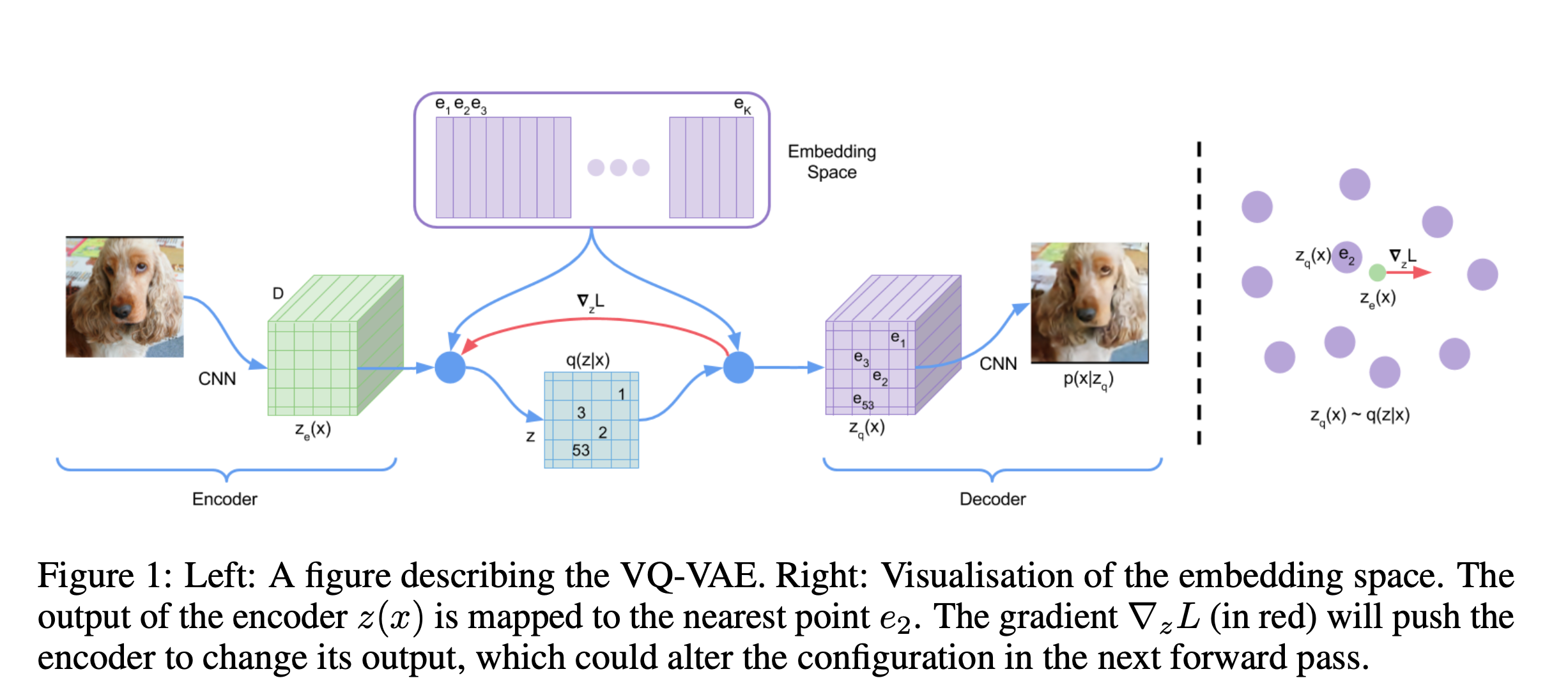
Latent embedding space \(e \in \mathbb{R}^{K \times D}\)를 정의하는데, 이때 \(K\)는 discrete latent space의 크기( \(K\)-way categorical, 각 embedding vector는 \(D\)-dim). Encoder 통과시킨 뒤 codebook에서 nearest neighbour look-up 과정을 통해 codebook의 index만 저장.
\[q(z = k \mid x) = \begin{cases} 1 & \text{for } k = \arg\min_{j} \| z_e(x) - e_j \|_2, \\ 0 & \text{otherwise.} \end{cases}\]따라서 quantized 된 인코더의 출력은 다음과 같습니다.
\[z_q(x) = e_k, \quad \text{where } k = \arg\min_{j} \| z_e(x) - e_j \|_2.\]여기서 생각해볼 것은, 위 식의 real gradient는 정의되지 않는다는 것입니다. 따라서 저자들은 decoder의 gradient를 encoder에 그대로 흘려주는 방식으로 이를 approximate 했다고 합니다.
2.2. Learning
learning objective는 3가지로 구성됩니다.
\[\mathcal{L}(\mathbf{x}, D(\mathbf{e})) = \| \mathbf{x} - D(\mathbf{e}) \|_2^2 + \| \text{sg}[E(\mathbf{x})] - \mathbf{e} \|_2^2 + \beta \| \text{sg}[\mathbf{e}] - E(\mathbf{x}) \|_2^2\]- Reconstruction loss : encode/decode 과정을 거친 이미지와 원본 이미지 비교.
- Codebook loss : 인코더는 freeze하고 codebook만 업데이트.
- Commitment loss : codebook은 freeze하고 encoder만 업데이트.
Generating Diverse High-Fidelity Images with VQ-VAE-2
NeurIPS 2019 [Paper]
Ali Razavi, Aaron van den Oord, Oriol Vinyals
DeepMind
2 Jun 2019
TL;DR
VQ-VAE에서 hierarchical 구조, Latent code의 prior학습을 통해 VQ-VAE2 제안.
1. Introduction
VQ-VAE를 업그레이드 한 방식인 VQ-VAE2를 제안합니다. Lossy compression의 아이디어를 활용해서 생성모델이 사소한 정보를 모델링 하지 않도록 하면서, VQ-VAE와 같이 VQ-quantization을 활용해 discrete latent space로 이미지를 압축하는 것입니다. 메인 아이디어는 크게 2가지 입니다.
- Learning Hierarchical Latent Codes
- Learning Priors over Latent Codes
2. Method
2.1. Learning Hierarchical Latent Codes
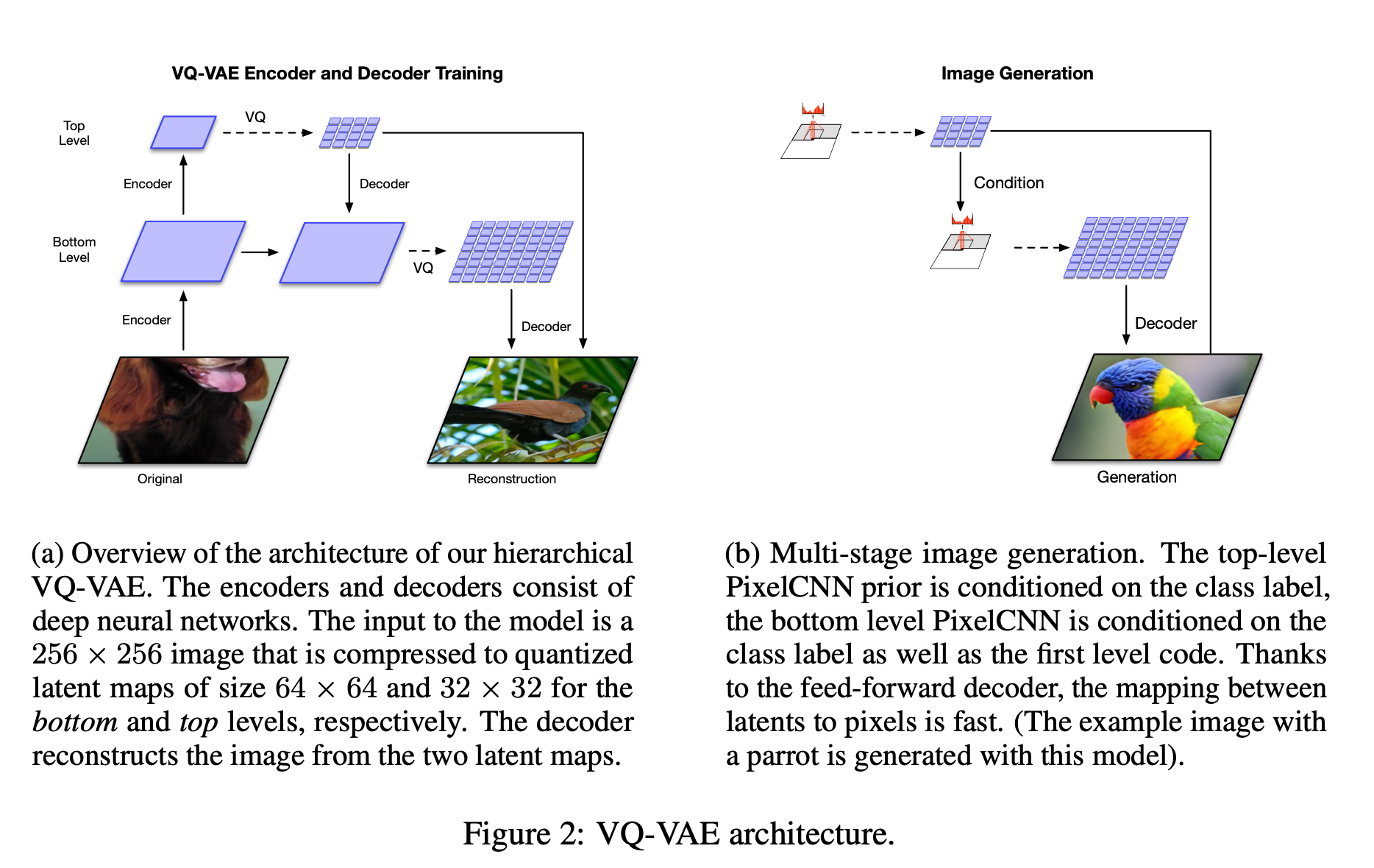
VQ-VAE와는 다르게 hierarchical 구조를 사용합니다. Global, local 정보를 나눠서 학습하기 위함이라고 합니다.
- Global : Shape, Geometry 같은 정보, Top level에서 학습.
- Lcoal : Texture 같은 정보, Bottom level에서 학습.
3.2. Learning Priors over Latent Codes
학습 데이터로부터 prior distribution을 fitting하는 것은 성능을 크게 향상 시킬 수 있다고 합니다. Information theory 관점에서는 이 과정을 lossless compression으로 볼 수 있으며, latent variable을 re-encoding하여 더 정확한 분포로 근사하는 것이라고 합니다.
VQ-VAE2에서는 PixelCNN과 같은 강력한 AR모델을 사용해 auxiliary prior를 모델링 했다고 합니다.
